Your website will not retain people for very long if your pages are typical. On average, around half the people who visit a website disappear immediately the page opens – they “bounce” out. And even if they do stay on your web page for any reasonable length of time, research shows that the average amount of each web page that is read by visitors is a mere 20%. Even at the “high end” only 28% of a web page is read.
Online, people scan. They rarely read every word. We look at headlines, sub-headings and visual clues as to what the page contains. We skim read. And therein lies a problem.
Skim reading means we only truly understand things if they are written at a very low level. Even if you have a Ph.D. in rocket science, the chances are when you skim read something you can only understand it if it has a reading age of around 10 years old. In other words, if your website is not aimed at primary school children, most of your readers simply will not understand your material.
And now there is another problem – Google. The search giant is now assessing reading age of web pages and using that to help make ranking decisions. At the moment, Google is merely presenting search results according to readability using the “advanced search” option.
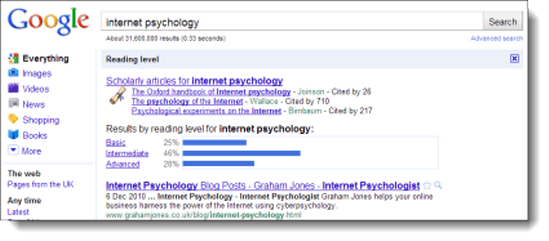
It presents the results as “Basic”, “Intermediate” or “Advanced”. Check several typical search terms and you find that most websites are in the two higher levels – making much of the web apparent nonsense when we skim read. Indeed, several studies have shown that significant slices of the web are written for people who have graduate level English. And that’s before we take into account the fact that many people reading websites will be doing so in their second, or third tongue.
In other words, vast swathes of the web are useless. Full of stuff that is brilliantly written for brilliant minds, or confusingly written by confused ones…!
Here’s what to do. Check your web readability and make sure it is at primary (elementary) school level. Firstly, that’s the best way people can engage with your content, given that only 20% of the page will be read and that most of your readers will be skimming.
But, there’s also the Google benefit. By taking into account the readability of web pages Google will be able to obtain data which helps rank sites. Expect highly readable, low reading age material to get higher rankings than anything “advanced”. You have been warned…!


Hi Graham,
Interesting article.
What troubles me a bit is that this mechanism will make our intersting language use less mature and -in my humble opinion- less interesting.
Personally, I love reading the newspaper and finding out words I did not know they existed.
My question: will your rule always apply, or is there room for websites that do use a bit more complicated English (or Dutch)?
Best regards,
Mark
Hi Mark
Thanks for your comment. There will always be room for "interesting language" – but that means Google is less likely to rank such web pages as high as competing pages with more "low level" language. It is another area where Google's algorithm makes an assumption – the assumption that we are all the same and all want the same. It is a significant flaw, which the readability checker exposes.
If you want your web pages to rank highly and to be seen by more people you simply have to use "low level" language. But if you want to provide alternative writing that's fine if you are happy to accept you will need to get visitors in ways other than via Google.
Graham
It’s a sad day for all of when we’re challenged to ‘dumb-down’ websites so that they receive higher google search rankings.
I submit that readers skimming your web page and only reading 20% of the content are probably not those that you really value all that highly anyway!
I am not suggesting you “dumb down”. Readability is about being understand the material and all the research on reading shows that even for PhD level work, a low reading age works best. We may think this is dumbing down, in reality it is making the text approachable and enjoyable.The skimming of web pages is being done to see if it is readable. If it is, then people go back and read the page. In other words making it readable – in your words dumbing down – actually means you will get more of the people you value, not less.