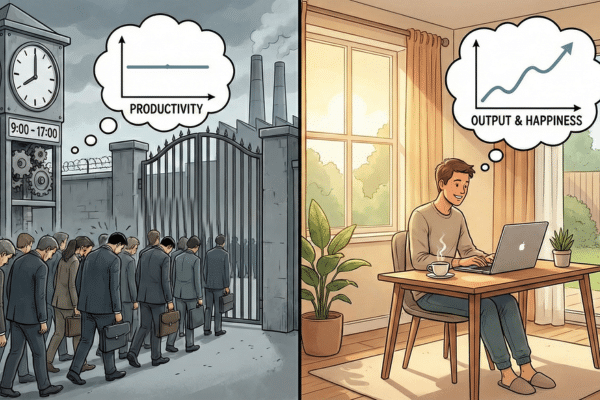
As you read this, sipping your morning coffee on a relaxing Saturday, spare a thought for me because I am working. I am a Keynote Speaker on a webinar hosted in Sri Lanka. If you hurry, you can catch it “live” on Facebook at this link. Also, when I wrote this article, it was late last night, and I was still working after a full day. But I haven’t ever worked a “9 to 5.” I suspect you, too, might not keep to strict working hours either.
The “9 to 5” was invented in 1926 by Ford. Up until then, the concept of a strict set of working hours was unknown. The idea of the “9 to 5” routine is only 100 years old. For centuries before that, work was unregulated. Henry Ford noticed that when he limited people’s working hours, they became more productive. This is confirmed by research from Henley Business School, which shows considerable benefits from working fewer hours than the strict Monday-to-Friday 9-to-5 schedule, including increased productivity.
Economists have been scratching their heads for decades as to why productivity has flatlined since 2007. I have never understood, for instance, why everyone commutes to work at roughly the same time. The roads are at their slowest speeds during the “rush hour” because so many people are travelling to work. The trains are packed with standing room only. Wouldn’t it be more productive if businesses did not all start at 9.00 am? But no, every business issues a contract to its staff with roughly the same working hours. Then they wonder why their workers are stressed, having commuted for longer than necessary. So, to “fix” that, it seems people are now expected to work even longer, stretching their stressful workdays further and harming productivity.
New research from Australia confirms the impact of commuting stress. The University of Melbourne economists found that commuting affects men’s mental health. For women, working from home improves their mental health. Indeed, for many people, commuting adds the equivalent of an extra workday every week. The researchers’ message is that employee mental health, which is linked to productivity, is boosted when everyone has flexible working arrangements. The study also suggests that policymakers consider changes to encourage flexible working. One way they could address my pet peeve about commuting is to attach working-hours conditions to planning permission, forcing businesses to have different start times.
Yet, despite years of research suggesting the “9 to 5” does more harm than good and that increasing working hours is counterproductive, we live in a world where bosses expect us to work longer and stick to a routine. This is reflected in growing numbers of “Return to Office” edicts, which workers do not like, say researchers at King’s College. Bosses want to see you working. They don’t appear to believe – despite all the evidence to the contrary – that homeworkers are happier and more productive, as long as they can be flexible about their working hours. Many bosses appear wedded to the principles of Henry Ford from more than 100 years ago.
That is reflected in the recent changes to Microsoft Teams. It can track your location to provide bosses with a report saying when you started and finished work and where you were when you did so. This heralds in inevitable HR meetings to discuss a worker’s commitment. Once again, it is bosses who focus on measuring inputs rather than outputs.
There is a vast amount of employment legislation about working hours. It’s only there because some bosses would exploit workers without it. A true leader recognises that people are happier in their job and more productive when they can work flexibly and when their boss does not monitor them. However, business leaders who do this start to worry that the work will not get done and that their staff will exploit them.
Ultimately, this is about trust. Employers don’t trust their staff, so they issue return-to-work orders and monitor activity through Microsoft Teams. Staff reciprocate by not trusting their bosses and demanding the protections offered by employment legislation. That inevitably leads to the enforcement of the “9 to 5”, and we’re back in unproductive, stressful territory. So, if you are a boss, give your head a wobble and start to rethink your attachment to “9 to 5”. Your business will benefit, as will your staff.