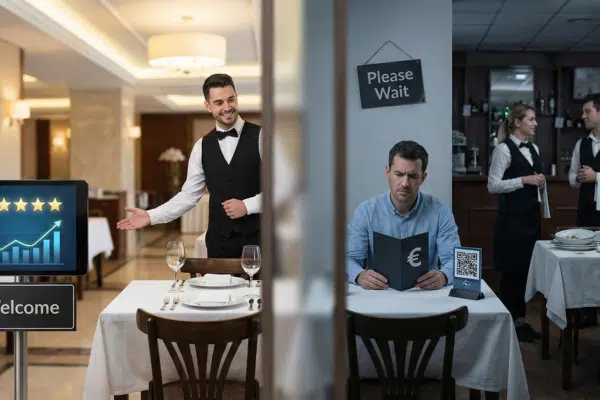
On Thursday, I went down to Bristol to see a show. It was the only opportunity I had as the tour was coming to an end. Before the show, I went to a well-known restaurant chain for a bite to eat. There was a sign saying “Please wait to be seated”, so I followed the instruction. It was about three minutes before any of the waiting staff came to talk to me, even though a couple had walked past me.
The restaurant was three-quarters empty as it was relatively early in the evening. Even so, there was no table ready for me. So, I was asked to wait while they set off to wipe down a table and arrange the place setting. Eventually, I was guided to my seat and for the third time in our brief encounter, I was asked if I had any allergies. I was handed a menu. I then waited almost ten minutes before anyone came to take my order, but before they did that, the individual who had previously quizzed me asked once again if I had any allergies. I was beginning to wonder if this wasn’t a restaurant but a secret antihistamine factory. I know they legally have to ask, but how many times…?
At the end of my meal, I tried to pay. There was a sign on the table asking to pay online using the QR code shown. That took me to the company’s website in Ireland, so it was unable to find my restaurant in the list, as I was clearly in England. Then I noticed that the sign had several offers on it, all priced in Euros, not pounds. Nobody at the restaurant appeared to have realised they had been sent the wrong documents.
I left the restaurant wondering what their customer experience scores were. So, I looked at their online reviews and found they were rated 4.5 stars, with a string of glowing comments. The restaurant thinks they are doing well. After all, their TripAdvisor scores are high, their Trustpilot ratings are very good, and their Google reviews are excellent. Then it struck me. I hadn’t told them that I had waited too long, that I was fed up with being questioned about my allergy status and that their signage was for the wrong country. I wondered how many other people had also neglected to tell them of their failings.
As if by coincidence, when I was checking the latest research news yesterday morning, I discovered a study showing that the number of people reporting a poor customer experience is falling dramatically. There was a 7.5% drop over the past year alone, continuing an ongoing trend. Worse still, the number of people talking about poor customer experience on social media has also dropped. So too has the number of people rating companies negatively on review sites. The result is that businesses, possibly including yours, are being lulled into a false sense of security that they are doing well when they are not. The visible data they can see is dramatically biased.
This is important because another study shows that the demand for good customer experience is increasing. Almost four in ten people now expect better customer experience than they got a year ago. If complaints are falling and expectations are rising, silence is no longer a sign of reassurance. It is a risk.
This presents a conundrum for companies. Your customers expect more of you. So, no doubt you’ll check your reviews and discover you are “doing well”. What those reviews miss are the people who have a poor experience but don’t tell you. I will not be the first person to have visited that Bristol restaurant, had a bad experience, told nobody, but will never go back again. Poor customer experience leads to a constant need to acquire new customers, which is the most expensive way to gain business.
Restaurants think they get good feedback by asking if “everything is alright”, usually when your mouth is full, and all you can do is nod back. Few people, at that point, will say, “Well, not quite – you made me wait too long, I got fed up with all the questions about allergies, and your menu is in Euros instead of Pounds”. Asking your customers if everything is OK is useless, as they will not tell you the negatives. Yet to improve the customer’s experience, you need to understand those issues.
The trick to solving this is more straightforward than many businesses think. They set up a range of complex analytics to assess customer experience. Yet, the simplest way is to be a customer. This could mean using “mystery shoppers” more, conducting customer focus groups, or, if possible, having business leaders be customers themselves.
Or, as I discovered last week, you could ask your staff. I was at a supermarket and got one of those random bag checks at the self-service checkout. The lady who did it revealed that their supermarket did these checks more often than the competition. “How do you know that?” I asked. She then told me that despite her discount at the store she worked, she preferred to shop at the competition because “it was a much better experience”.
When your staff reckon you provide a bad customer experience, that should be a massive red flag. I often wonder how often business leaders talk to their frontline staff. Doing that more often will also help you discover how to improve your customer experience and reduce your need to acquire new customers constantly.