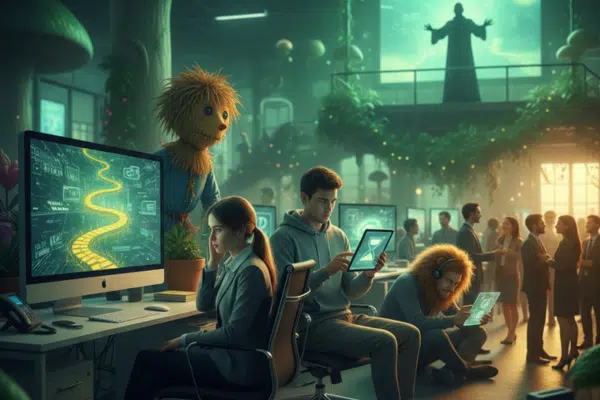
It’s the time of year when The Wizard of Oz gets an outing, and families gather around to travel down that yellow brick road one more time. Children worry about the lion’s fearfulness. They get concerned by the tin man, who seizes up at the slightest provocation. Plus, they laugh at the scarecrow’s inability to think. These characters are a right bunch of no-hopers.
However, speaking with some friends this week, I found that such behaviour is increasingly present in the workplace. For example, one NHS worker told me that there was a decline in respect for doctors who are currently on strike for more pay. My NHS friend tells me that the modern resident doctor is struggling. They may ring in to say they cannot come to work at the slightest issue, such as having a headache or an episode of stress. With repeated crying off work while demanding sky-high pay rises, it’s no wonder they are losing sympathy.
But let’s not be too critical. These young doctors do a fantastic job and have been trained, at high personal cost, for several years. Besides, my friend in the world of accountancy says that young accountants behave similarly these days. They ring in sick but have no identifiable clinical issue, he tells me. Plus, many have self-diagnosed themselves with ADHD without any proper clinical diagnosis. They claim this means they cannot work under any kind of pressure and therefore need to do less.
Meanwhile, a contact in the IT sector tells me that there are legions of workers moaning about the pace of change. They are finding all kinds of reasons not to alter what they are doing, erecting barriers to demands for change from their leadership. They don’t want to do the additional work, as it is going to be too tricky or mentally taxing.
Wherever I have looked this week, I have found examples of lions, tin men and scarecrows in the workplace. A bunch of people who are struggling. They get stressed at the slightest thing. They think they are being asked to do too much. Or they believe they are owed time off for what some of us might consider trivial matters. People don’t appear to be able to think, or they seize up easily, or get scared by change. What is going on?
Luckily, there have been some interesting pieces of research published in the past week that intersect and show us a way out of this. The first clue came from a study by the AI Security Institute, which found that one in three people who use artificial intelligence do so for emotional support. Indeed, many people are replacing social interaction with chatting with an AI system. When the AI system failed, the study showed that there was a subsequent increase in anxiety and poor sleep because people couldn’t talk to “their friend”.
Meanwhile, in Leicester, a consultant at the local children’s hospital has identified that many youngsters are getting “acquired ADHD”. This happens when children spend more time on screens than on physical activity. It is entirely different, says the doctor, from “primary ADHD”, which is not curable. Simply getting those screen-obsessed children to become more active removes the symptoms of ADHD.
You can see a pattern. People who spend hours on screens have no one to talk to and end up making friends with AI. This leads to even less physical activity, and it is no wonder that you get people like young accountants reporting they have undiagnosed ADHD or higher amounts of stress and anxiety. Another piece of research backs this up. A review of studies on the use of “short form videos”, such as on TikTok, shows that constant viewing of these leads to cognitive impairment and poor mental health.
One other piece of research provides the answer as to what is going on. The Association for Psychological Science in the USA suggests that simple changes in our cells’ mitochondria are to blame. Mitochondria are tiny powerhouses in most of the cells in our bodies, helping to generate energy. This latest biological research shows that when we become less physically active, these mitochondria cease to function efficiently. In turn, poor mitochondrial function is linked to stress, anxiety and other symptoms of poor mental health. There is another twist to this, too. Mitochondrial functioning improves when we are more social.
This helps explain why we are seeing a high level of stress, anxiety and concerns for mental health. As people become more isolated and less physically active, their mitochondria start to break down. This leads to mental health issues and symptoms akin to ADHD. People then turn to their trusty online AI friend, which can reinforce the belief, and they tell their bosses they cannot work or need less pressure.
There is a simple solution to this that will start to get rid of those lions, tin men, and scarecrows from your offices. Improve your employees’ mitochondrial function by increasing the number of face-to-face meetings. This will get people off their butts and improve social connections. That will alter mitochondrial activity and reduce stress, anxiety and other issues that make people think they have ADHD. Cut down on online meetings and increase in-person meetings, and you’ll see a change in staff behaviour and attitudes.
Hey presto, that’s this year’s Christmas magic trick for you. Gosh, you might think I’m a wizard.
Happy Christmas.


