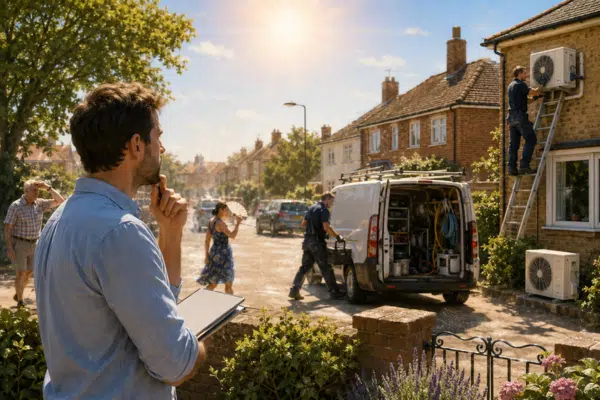
Here in the UK, we’ve had record-breaking temperatures every day this week. Yesterday, the mercury got to 37.3 degrees. We all wish we had air conditioning.
Indeed, in the space of a few days, air conditioning sales in the UK have rocketed. That’s not surprising, because air conditioning remains far less common in the UK than in countries such as Japan or the United States. Nine out of ten people in Japan have air conditioning, and almost two-thirds of homes in the USA have it.
Clearly, there is an “open door” here, with a significant market opportunity in the UK. However, it’s probably too late. Those businesses that saw the opportunity several years ago will now be raking in the cash. By the time you or I could get up and running with an air-con company, we’d be in the depths of winter, and nobody would be thinking about getting cool.
This is a conundrum for entrepreneurs. What business can you start now that will have a significant market in the future? Consider Nvidia, the world’s most valuable company. They did not start working on microchips for artificial intelligence when we all heard about ChatGPT in 2022. Nvidia had invested in the work needed to create AI chips way back in 2006. They had a 16-year run-up. When they began developing the programming required for AI, it was almost a decade before OpenAI was even a twinkle in Sam Altman’s eye.
The pioneering entrepreneur is often the one who establishes a market and can hold onto it for a long time. Research from the University of Michigan suggests that market pioneers are not more likely to fail than later entrants. They may face higher costs at the start, but over time, they can earn stronger profits. In other words, waiting for someone else to prove the market exists is not always the safer strategy.
Clearly, there’s no way we can become pioneers in the decades-old air conditioning sector. The people making money out of the heatwave will have been in business for years. The question is: what business can we start now that would enable us to pioneer a new sector?
To start our search, it is worth looking at the kinds of things happening now that are going to become mainstream in the future. One of those trends is the ageing population. In the UK, there are currently around 3 million people aged over 80. In 20 years, that number will have risen significantly, says the Centre for Ageing Better. At the same time, the proportion of younger people aged under 35 will fall. There are plenty of services and products aimed at older people. So we need to look for what is missing. One area could be in care coordination. Older people will have a variety of care services in the future, but who will organise them? The NHS cannot cope as it is. There’s a clear gap here for a business that is not likely to be needed on a significant scale now, but in a decade, your business could be the pioneer.
If that doesn’t interest you, what about cashing in on the “right to repair”? New laws, such as the EU’s Right to Repair, mean that from this July, manufacturers will have to design products so we can repair them ourselves when they break down. The UK also has legislation on this. Part of the thinking behind such laws is that expensive repairs mean products are just getting thrown away. Remove that expense, and countries can improve sustainability. But who is going to teach people how to repair things, or support them? There’s another gap waiting to be filled.
What about the impact of AI? As the world becomes increasingly filled with manual labour robots, digital bots, and AI-driven work, human contact will be missing. Filling that gap is likely to create significant demand for which someone could start a pioneering business right now.
Finding gaps that few people are filling now is what is needed to create a business for the future. Rather than looking for businesses that bring in cash now, being a pioneer that looks to money from the next decade is where you want to be. That’s exactly where those air conditioning companies are now. I bet their friends said they were mad when they set up their firms, while the UK didn’t have high temperatures.
It reminds me of Sir William Preece, the Chief Engineer of the Post Office in 1878, who said, ‘The Americans have need of the telephone, but we do not. We have plenty of messenger boys.’ My guess is that ten years ago, more than one person said the UK would not need air conditioning. I bet they are hot under the collar now, wishing they had started an air conditioning company.


