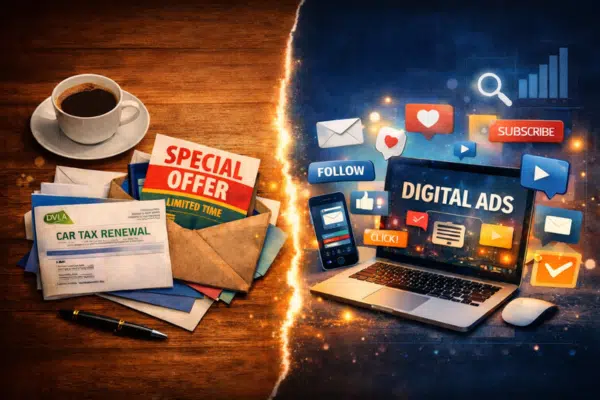
Last night, as I was settling down for an evening of binge-watching, a friend sent me a WhatsApp photo of something that had just dropped through her letterbox. It was a piece of direct mail, and I replied with some quip about it being old-fashioned.
Even so, the leaflet had caught my friend’s attention, so much so that she thought it worthwhile sending messages about it. In the same way, earlier in the evening, I had paid attention when I opened the post to find a reminder from the Driver & Vehicle Licensing Agency that my car tax is due in a couple of weeks. Even though I had seen the notifications on my phone about my car tax, I had done nothing about them. Only the “old-fashioned” item of print caught my attention for long enough for me to take action.
Of course, I can hear you saying, “But Graham is a ‘Generation Jones’, and so he is bound to like these old ideas.” (Yes, there is such a thing as “Generation Jones”, which came after the Baby Boomers and just before Generation X.)
However, it has nothing to do with age. It’s all about the “marketing mix”. Marketers understand that people need several reminders of a marketing message in a variety of formats before they take any action. Yet these days they appear to be abandoning that basic principle.
Recent reports show that each year marketers are pushing more and more of their spend into just one form of promotion, digital marketing, giving up on those other elements of the marketing mix. Last year, 73% of worldwide advertising spend went on digital-only forms of promotion. In the UK, the picture is worse because we increased our digital advertising spend by 10%, compared with the worldwide average of almost 3%. According to Datareportal, the UK and the USA spend significantly more of their GDP on digital advertising than most other nations. Here in the UK, advertising spending as a share of GDP is among the highest in the world, suggesting we have become unusually dependent on digital visibility. It is as though we have become obsessed with digital marketing at the expense of everything else. Have we forgotten that other forms of marketing and promotion exist?
Industry research from firms working in direct mail consistently suggests that combining direct mail with digital channels can improve response rates, lead quality, and return on investment. For example, this report from Franklin Madison Direct, a marketing firm based in Minnesota, USA, shows that combining digital marketing with direct mail dramatically improves performance. Indeed, marketers in the study reported better lead quality when direct mail was used alongside digital marketing.
The study confirms work from a couple of years ago by the San Francisco software company, Lob. This showed that when direct mail is used, the return on investment is higher compared with other forms of marketing.
In the meantime, despite all this research to the contrary, we appear to be rushing headlong into spending even more money on digital marketing. Decades of marketing research have shown that the marketing mix is fundamental to success. Why are we focusing so much on just one type of promotion and on only one place where customers can find out about us – the digital world?
Even though I joked with my friend that the direct mail she received was “old-fashioned”, it clearly is not, as it worked by grabbing attention. Perhaps it is time to check on our assumption that digital marketing should reign supreme. It is only part of the mix.


