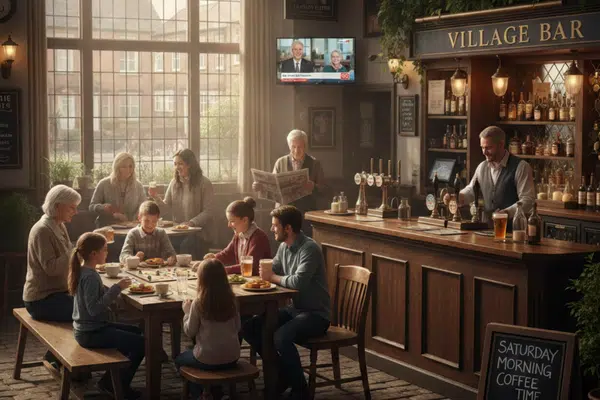
With newspapers around the world dominated by the idiotic, ignorant and insulting ramblings of an older man past his prime, you might have thought I would start this week talking about him. Instead, I want to focus our minds on something that has remained stable in British society for centuries, the good, old-fashioned pub. I want to do this because the world’s headlines have been so dominated by one person that the newspapers were unable to find space to report a significant and historic event in the UK. The Tamworth Tap in Staffordshire has been awarded “Pub of the Year” for the third time. This has never happened before.
To achieve this extraordinary effort, the pub had to do much more than provide good beer. The Campaign for Real Ale, which gave the award, said that one of the reasons for the victory was the fact that the pub is “the centre of its community, becoming a social hub by hosting a huge range of daily events”.
It reminds me of the pub in our village, The Hinds Head. It is a community hub that also serves fantastic food. Indeed, when we hear that so many pubs are closing due to unaffordability, it’s interesting to see that where I live, there are two pubs that are highly successful, the other being The Butt Inn. Both focus on providing great grub, but also focus on community. You have to wonder if the failing pubs are missing out on something important.
The Pub of the Year and my two locals thrive on bringing people together and being at the heart of the community. Indeed, that’s what the traditional British pub has been about forever.
But the same feature is also central to many successful businesses. Take Apple, as an example. It has just 28% of the global phone market, with Android dominating. Worse still for Apple, its computer market share is less than 4%. In short, the vast majority of phone and computer users worldwide do not use Apple products. Yet, despite these dismal market share statistics, Apple is the second-most-valuable business in the world, ahead of Google, Microsoft, and Amazon. One of the keys to their success is building a community of users. Apple users are so proud to be part of that community that there is no need to enquire whether someone uses an iPhone; they’ll tell you before you even ask.
Other brands have also established significant communities. Harley-Davidson, Gymshark, LEGO, Peloton and Salesforce all have thriving communities that bind customers together and help ensure future loyalty to the brand. Research published last year in the International Journal of Social Impact underlines the fundamental value of community in profitability.
We are living in a world of increasing division. Indeed, research from King’s College London last year showed that 84% of people in the UK believe the country is more divided now than before. Half the country is nostalgic for the past, say the researchers. But it is not the past people really want. What they mean is that they want to reduce division and feel bonded together again. They want community.
So do your customers. They want to feel part of a group that “belongs” to your business. Part of that is the need for reassurance that they have made the right decision in buying from you. By creating a community of customers, you help achieve that, and with it, lasting loyalty to your firm. You should be just like a pub landlord and not like a geriatric rambler who merely seeks to divide. He might not have noticed, but in trying to divide, he is actually creating communities of people joining together in their common goal of showing just how ill-informed and ignorant he is. Now you have to guess who I am talking about.


