A Field Guide for Business
Go ahead and Google “what is internet psychology.” What comes back is a curious jumble: a few academic papers behind paywalls, some university course pages, a handful of listicles about social media addiction, and not much that tells you what the field actually is or why it should matter to your business.
That confusion is telling. Internet psychology is a serious academic discipline and a highly practical set of tools for understanding how people behave online. Yet it has never quite found the clean, accessible definition it deserves.
Whether you run a business, lead a marketing team, design digital products, or want to understand why you and your customers do the things you do online, this is your field guide.
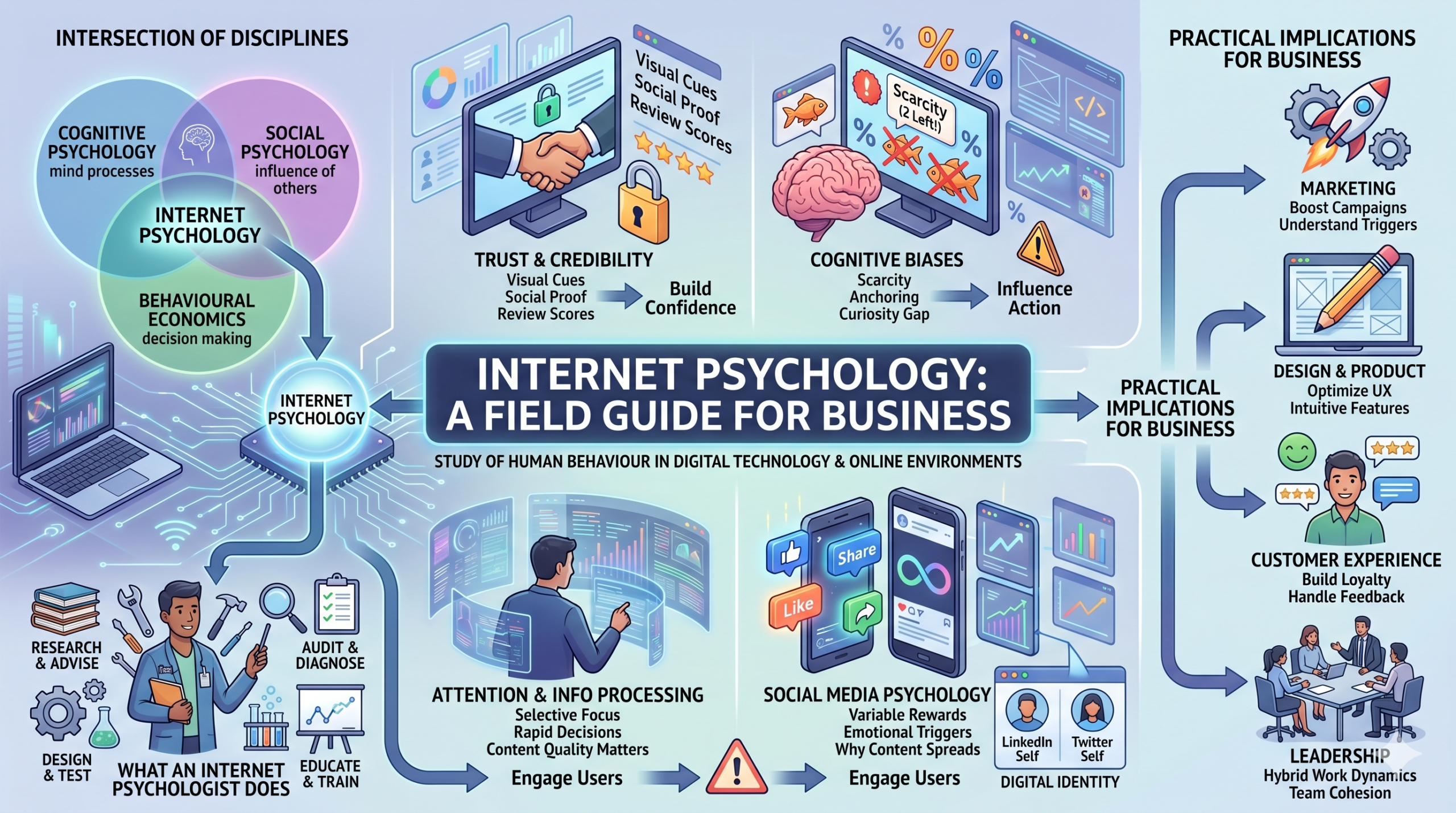
Defining Internet Psychology
Internet psychology is the study of human behaviour as it is shaped by, and expressed through, digital technology and online environments. It asks questions like:
* Why do people trust some websites and not others?
* What makes someone share a piece of content?
* How does spending time online affect the way we think, feel, and relate to one another?
* How can organisations use that understanding to design better digital experiences?
The field sits at the intersection of several older disciplines. It draws from cognitive psychology (how the mind processes information), social psychology (how people influence and are influenced by others), and behavioural economics (how we make decisions, often irrationally). To this, it adds the specific context of the internet, including its architecture, speed, anonymity, social structures, and extraordinary scale.
You will sometimes see the term “cyberpsychology” used interchangeably with internet psychology. Strictly speaking, cyberpsychology is a broader term encompassing interactions with all forms of digital technology, including artificial intelligence, virtual reality, robotics, and more. Internet psychology focuses specifically on online environments. In practice, the distinction blurs, and many researchers use both terms interchangeably.
What unites the field, whichever label you prefer, is a commitment to understanding digital behaviour. These are the observable choices people make when they interact with screens, apps, platforms, and each other through digital networks.
A Brief Academic History
The discipline emerged in the 1990s alongside the internet itself. Psychologists quickly recognised that online environments were not simply new venues for old behaviours. They created genuinely new conditions that existing theory struggled to explain.
Early research focused on two questions that seemed pressing at the time:
* Is the internet addictive?
* Does online communication change the way people present themselves?
Both questions generated substantial research, some of which remains influential today.
John Suler’s 2004 paper on the “online disinhibition effect” became one of the most cited in the field. Suler observed that people behave differently online than they do face-to-face. Sometimes, people online behave more openly and generously, but sometimes, more aggressively and rudely. The reasons include anonymity, the absence of eye contact, and the asynchronous nature of much online communication. Businesses that failed to understand this were surprised by the intensity of customer complaints on social media or confused by the warm communities that formed around their brands in unexpected ways.
As the internet matured from a novelty into infrastructure, the field of internet psychology matured with it. Researchers turned their attention to e-commerce, social networks, search behaviour, online health information, digital privacy, and increasingly to the algorithms and artificial intelligence systems that shape what we see and do online. Today, internet psychology is a busy, multidisciplinary field with active research groups at universities worldwide.
The Core Areas of the Field
Internet psychology is not a single topic but a cluster of related areas. For business purposes, the most relevant ones are the following.
Trust and Credibility Online
Trust is the engine of the digital economy, and it operates differently online than it does in person. In a physical shop, trust is built through sensory experience, the quality of materials, the behaviour of staff, and the layout of the space. Online, none of that is available. Instead, we rely on “trust signals” such as web design quality, social proof, certifications, review scores, the clarity of contact information, and dozens of other cues that the mind processes, largely unconsciously, within seconds of landing on a page.
Research by BJ Fogg at Stanford identified credibility as the central variable in whether people accept online information and take action. His work remains foundational for anyone designing a website or digital product intended to persuade. Subsequent research has built on this to map the precise visual, structural, and social factors that either build or erode confidence in online environments.
Cognitive Biases in Digital Contexts
The human brain applies the same cognitive shortcuts online that it uses everywhere else. However, the internet is unusually good at exploiting them. Scarcity (“only 2 left”), social proof (“38 people are viewing this”), anchoring (showing a higher price before a lower one), and the curiosity gap (a headline that withholds just enough information) are all applications of well-documented biases that digital designers and marketers deploy, sometimes deliberately, sometimes by intuition.
Understanding these biases matters for two reasons. First, it helps businesses design more effective digital experiences. Second, it helps businesses avoid the ethical and reputational risk of exploiting those biases in ways that feel manipulative to customers. The line between influence and manipulation is probably thinner online than anywhere else, and customers have become increasingly sophisticated at sensing when they have crossed it.
Attention and Information Processing
The most contested claim in internet psychology is probably the idea that the internet has shortened our attention spans. The “eight-second goldfish” statistic. This suggested that human attention online had fallen below that of a goldfish, a claim that was widely reported and is almost entirely fabricated. The actual research paints a more nuanced picture: human attention online is highly selective, task-dependent, and heavily influenced by content quality and environmental design.
What is well established is that the competition for attention online is extraordinary, and that people make rapid, often unconscious decisions about whether a piece of content is worth their time. Internet psychologists have developed detailed models of how that assessment works, and what it means for content strategy, website design, and communication.
The Psychology of Social Media
Social media platforms are, among other things, enormous psychological experiments. Their designers have applied behavioural science with considerable sophistication. This includes variable reward schedules (you don’t know if your post will get many likes or few), social comparison mechanisms, and the architecture of infinite scroll, all of which draw on research in psychology and neuroscience.
For businesses, the implications are significant in two directions. As a marketer, understanding why content spreads, including what emotional triggers, social dynamics, and cognitive shortcuts drive sharing, is directly useful. As a leader or HR professional, understanding how social media affects employee wellbeing, team cohesion, and organisational reputation is increasingly essential.
Digital Identity and Behaviour Change
People behave differently across online contexts and often present different versions of themselves to different audiences. LinkedIn-you is not Twitter-you. The you who leaves reviews is not the you who reads them. Internet psychology has mapped much of this variation, drawing on social psychology’s theories of identity and combining them with the specific affordances of digital platforms.
This matters for businesses because customers are not consistent, unified individuals whose preferences can be read off from a single data point. Their digital behaviour is contextual, audience-aware, and influenced by the platform they are using at any given moment.
Why Internet Psychology Matters for Business
Here is the point that gets lost when the field is discussed purely in academic terms. Internet psychology is not an abstract intellectual exercise. It has direct, practical implications for almost every dimension of how businesses operate in a digital age.
In marketing and communications, it explains why some campaigns cut through while others disappear. It identifies the cognitive and emotional levers that drive attention, engagement, and action — and the ethical limits on pulling those levers.
For website and product design, it provides a research basis for decisions that are often made on intuition: why certain layouts convert better, why users abandon particular journeys, and why some features feel intuitive while others feel frustrating.
In terms of customer experience, it explains the trust dynamics that underpin purchasing decisions, the review psychology that shapes reputation, and the complaint behaviours that can amplify or contain a crisis.
For leadership and organisational culture, it addresses the human dynamics of distributed and hybrid work, how digital communication affects collaboration, psychological safety, and the informal networks that hold organisations together.
For public affairs and policy, it informs questions about persuasion, misinformation, algorithmic influence, and the ethics of digital design that are now firmly on the regulatory agenda.
In each of these areas, the gap between what organisations do by instinct and what the research suggests is often significant — and usually expensive.
What an Internet Psychologist Actually Does
The job title is relatively rare, which partly explains why the field is under-known. An internet psychologist typically does some combination of the following.
They research and advise. This means reading the academic literature, distilling it for non-specialist audiences, and translating it into recommendations for specific business contexts. What does the research say about the trust cues most relevant to this sector? Which cognitive biases are most active in this purchasing journey?
They audit and diagnose. This means looking at an existing digital presence, such as a website, an app, a social media strategy, or an email campaign, and identifying where the psychology is working and where it is not. Why is the conversion rate low on this page? Why does this campaign generate engagement but not sales?
They design and test. This means contributing to the design of digital experiences, marketing campaigns, and communication strategies, with psychology built in from the start, and then testing the results. Behavioural science without measurement is just educated guessing.
They educate and train. This means building psychological literacy inside organisations so that teams can apply the insights themselves, rather than depending on an external consultant for every decision
Common Misconceptions
A few things internet psychology is often confused with, but is not.
It is not “digital addiction therapy”, though the field does include research on problematic internet use. Most of its applications are in design, marketing, and organisational behaviour.
It is not “surveillance or manipulation”. Understanding how people behave online does not mean exploiting that understanding unethically. The most durable applications in the field are those that use psychological insight to improve digital experiences for users genuinely.
It is not “the same as UX design”, though there is significant overlap. Internet psychology provides the research foundation on which good UX is built; UX design is the craft of applying that foundation to specific products and contexts.
And it is not “social media marketing”. Internet psychology includes the psychology of social media, but it is a much broader field that addresses the full range of human behaviour in digital environments.
Where to Go from Here
This post is a foundation. Over the coming weeks, I will be working through the specific areas of internet psychology that matter most for businesses right now, such as trust signals, cognitive biases, social proof, dark patterns, the psychology of website design, and more.
Each post will build into a practical guide to the field. If you would rather not wait for each instalment, the best way to stay current is to subscribe to my Saturday newsletter, where I share the most useful research and apply it to business questions each week.
And if you are looking for something more focused, such as a team session or a keynote on digital behaviour for your next conference, I would be glad to have a conversation. You can find the details on my speaking page.
The internet has been running for 30 years. We understand a great deal about how people behave on it. It is time more businesses used that understanding.
References
Ariely, D. (2008). Predictably Irrational: The Hidden Forces That Shape Our Decisions. HarperCollins.
Fogg, B. J. (2003). Persuasive Technology: Using Computers to Change What We Think and Do. Morgan Kaufmann.
Fogg, B. J., Soohoo, C., Danielson, D. R., Marable, L., Stanford, J., & Tauber, E. R. (2003). How do users evaluate the credibility of Web sites? A study with over 2,500 participants. In Proceedings of the 2003 Conference on Designing for User Experiences (DUX ’03). ACM Press.
Kahneman, D. (2011). Thinking, Fast and Slow. Farrar, Straus and Giroux.
Microsoft Canada. (2015). Attention Spans: Consumer Insights. Microsoft Corporation. [The source of the widely-reported 8-second claim; the methodology has since been questioned by several researchers.]
Suler, J. (2004). The online disinhibition effect. CyberPsychology & Behavior, 7(3), 321–326. https://doi.org/10.1089/1094931041291295
Thaler, R. H., & Sunstein, C. R. (2008). Nudge: Improving Decisions about Health, Wealth, and Happiness. Yale University Press.
Turkle, S. (1995). Life on the Screen: Identity in the Age of the Internet. Simon & Schuster.
Turkle, S. (2011). Alone Together: Why We Expect More from Technology and Less from Each Other. Basic Books.