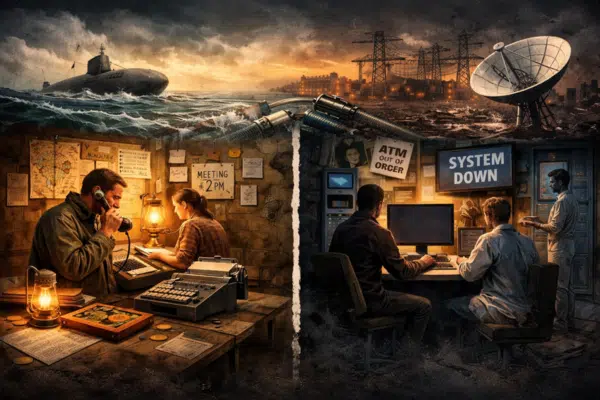
There can be no doubt that human beings can be extraordinarily resilient. This week, I listened to a radio interview with a resident of Kyiv, Ukraine. He explained that Putin’s bombers had destroyed the local heating system. Despite temperatures that were minus 15, people carried on as normally as possible. They found ways to keep each other warm and to ensure that the vulnerable were well cared for.
Meanwhile, over in Iran, thousands were being murdered by their rulers, yet people still protested against the brutal regime. In response, the despots in charge switched off the Internet in the hope it would stop people from organising protests via social media or messaging services. However, human resilience stepped in, and people found other ways of communicating. The Internet is slowly being restored in Iran, but there appears to be a plan only to allow certain kinds of people to use it.
Here’s the problem with switching off essential services. If you switch off heating, as in Ukraine, people can create other forms of warmth. If you remove Internet access, people can still communicate in different ways. The regimes that think that removing such services will force people into surrender haven’t taken into account human resilience and ingenuity. More importantly, as the Iranian regime discovered, you cannot switch off the Internet entirely. If you do so, you stop essential services from running. These are also the services that you need to rule if you are despotic.
Therein lies the problem for all of us. The Internet is so fundamental to everything we do these days that society could collapse without it. For a start, you could no longer read this newsletter…! How dreadful…! But you might also not have access to many healthcare services. At your local hospital, much of the information the medics rely upon is transmitted across the Internet from diagnostic centres, for example. Similarly, the control of your electricity or water supply is hooked up to the Internet. As for shopping, forget it. You would have no means of digital payment, and you couldn’t withdraw cash from an ATM, as that requires an Internet connection. Without the Internet, life as we know it ceases to function.
This might all sound rather doomsday. But don’t blame me for thinking about it. Tech experts say several scenarios could lead to the collapse of the Internet as we know it. Even if the entire thing does not collapse, those Russian subs circling our undersea cables only need to cut a vital link, and we could be without the Internet in the UK for weeks.
Of course, human resilience would step in, and we would find ways of coping. True, it would be inconvenient and frustrating. But not being able to communicate with your customers for a few weeks is hardly a problem compared with being frozen to death by a foreign dictator or murdered by your own country’s rulers.
There is no point in worrying about these “end of the world as we know it” scenarios. We can’t do anything to stop them from happening, unless you are in the Royal Navy and are heading off those Russian submarines, for instance. However, considering what we would do without the Internet is a worthwhile business exercise.
We have all suffered some kind of Internet outage. A server goes down, and it’s a day before it’s back up and running again. Or, your broadband supplier has a cable issue, and they can’t get you back online for several hours. Most people I have spoken with tend to find a positive in these frustrating situations. For example, it means they can get on with finishing some work without constant interruptions from emails and digital messages.
But what if such temporary Internet outages lasted longer? What would your business do without the Internet for a week? Or a month? True, these are low risk, but they are high impact. Often, we do not plan for low-risk issues. What’s the point? They are unlikely to happen.
It’s not the risk that matters, but the impact. Your business can reduce that impact by planning for the possibility that things might go wrong. Indeed, that’s the advice from experts on business resilience. Yet, 75% of small businesses have no disaster recovery plan. The lack of data backups has plagued businesses for decades. Without them, you dramatically reduce your resilience. Similarly, without a plan to handle major Internet outages, your business will suffer significantly. Don’t cry about the risk being low when the problem occurs.
True resilience requires forward planning. I would hazard a guess that people in Ukraine have stockpiled blankets in case the heating breaks. Or that people in Iran already had plenty of marker pens and paints ready to create posters and handouts to communicate without the Internet.
Our businesses also need to prepare for a complete lack of Internet access. Yes, it is very unlikely to happen, but if it does, the impact on your company would be huge. Unless, that is, you have planned to be resilient. If your Internet went down tomorrow, would your business survive the week?