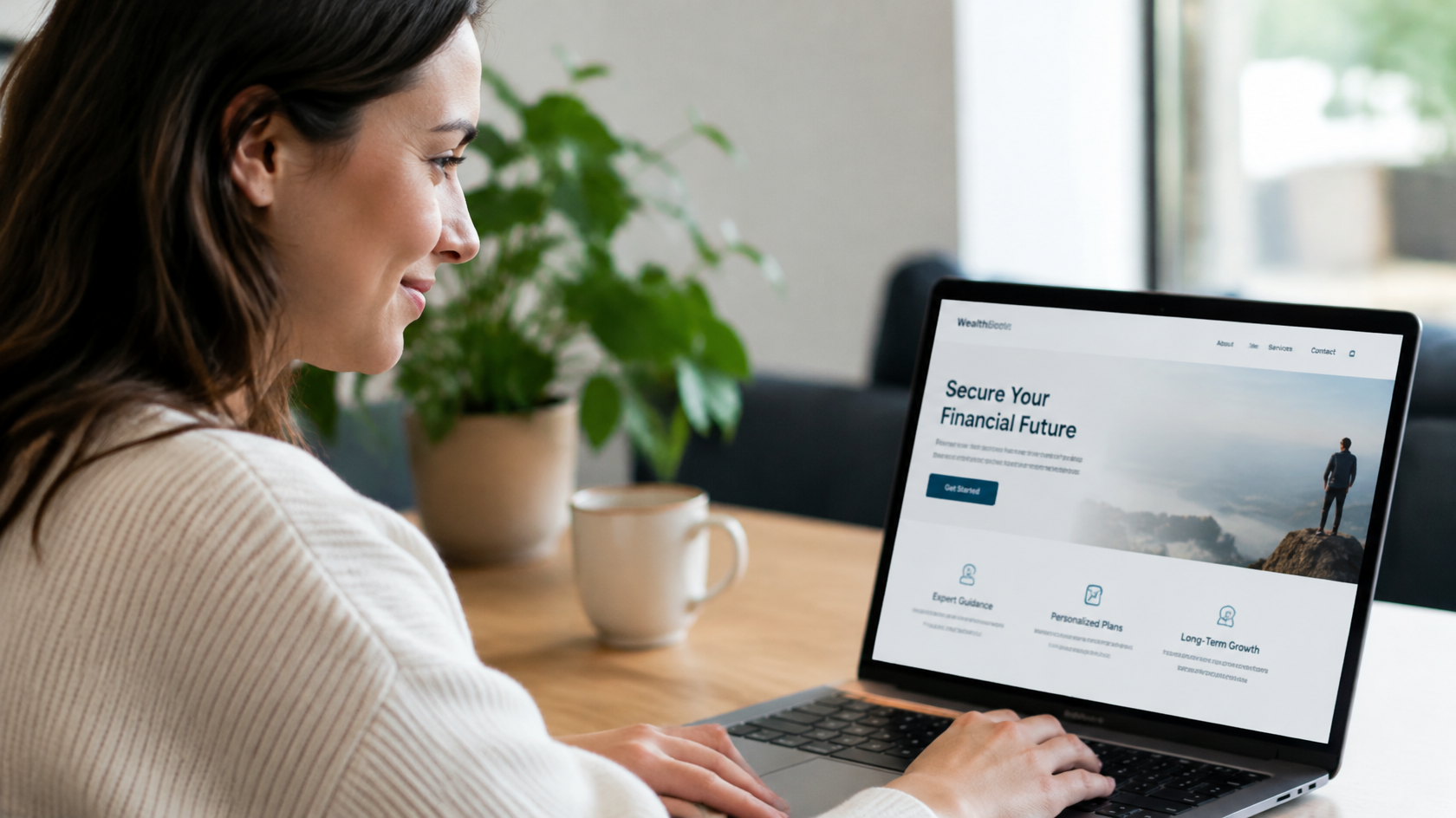
What makes people trust a website within the first few seconds?
People decide whether to trust a website almost instantly, based mainly on how it looks. A clean, professional design, fast loading, clear navigation and signs that a real organisation stands behind the site all create trust before visitors have read a single word. If the first impression is poor, most people leave and never give the content a chance.
The speed of this judgement is remarkable. Gitte Lindgaard and colleagues at Carleton University in Ottawa found that people formed impressions of web pages within the first 50 milliseconds, and that these snap judgements matched the views they formed after looking for longer. That is about a twentieth of a second, far too short to read anything. nature
Looks dominate credibility judgements too. In a large study by BJ Fogg and the Stanford Persuasive Technology Lab, 2,684 people evaluated real websites, and nearly half (46.1%) based their credibility judgements partly on the site’s overall design or look. Experts in health and finance paid far more attention to the quality of the content, but ordinary consumers relied heavily on appearance.
This happens because of the “halo effect”. A positive first impression colours later judgements about a site’s usability and credibility, and because people like to be right, they then seek evidence that confirms their initial view. A poor first impression works the same way in reverse.
So what builds trust quickly? A design that suits the purpose of the site and the expectations of its audience; visitors need to feel the site is “for people like me”. Fast loading. Clear contact details, real names and photographs of real people. No spelling mistakes or broken links. And restraint with advertising and pop-ups, because annoying adverts damage how visitors see a site. First impressions matter for brand loyalty, and if your site is failing that first test, it may be time to ask: Should you sack your web designer?
Does a company’s offline reputation still affect its online trust?
Yes, very much so. People do not separate a company’s online and offline existence. A well-known name, a good reputation in the community, positive press coverage and personal experience of a business all transfer to its website, while a poor offline reputation follows a company online.
Research on online shopping has shown this for decades. In a study by Sirkka Jarvenpaa, Noam Tractinsky and Michael Vitale, consumers noticed differences in the size and reputation of online stores, and these differences influenced how trustworthy and risky they judged the stores to be and whether they were willing to shop there. The researchers noted that this challenged the popular belief that the internet creates a level playing field for small and large retailers, and for those with and without an established reputation.
The psychology is straightforward. Reputation is a mental shortcut. When we are uncertain, as we are often online where we cannot see the shop, meet the staff or handle the product, we rely on what we already know about a company. A familiar, respected name reduces the perceived risk of handing over money and personal details.
The connection also works the other way. Offline experiences are increasingly shared online through reviews and social media, so a rude member of staff or a poor service experience in person can quickly damage a company’s online reputation. That is why businesses need to keep asking: How do you know if your customers are having a good experience?
For businesses, the lesson is to treat reputation as a whole. Traditional activities still matter: traditional public relations is often more trusted than online activity, and a good marketing mix still includes offline channels, as I discuss in Have we abandoned the art of mixing our marketing? (See also “Why do online reviews have such a strong psychological impact on buyers?” below.)
How do cognitive biases influence online shopping and decision-making?
Cognitive biases are mental shortcuts that help us make quick decisions but can lead us astray. Online, they shape almost every purchase: which price looks like a bargain, which option we choose from a list, whether we stick with a default setting and how much we end up spending. Many websites are designed, deliberately or not, to take advantage of them.
Anchoring is one of the most powerful. The first number we see acts as a reference point for everything that follows, which is why websites show a crossed-out “was” price next to the sale price. The decoy effect is similar: adding a deliberately unattractive option makes another option look better by comparison. You see this on three-column pricing tables, as I explain in Should you use decoy pricing?
Defaults are also hugely influential, because most people stick with whatever is pre-selected. Research by Eric Johnson and Daniel Goldstein on organ donation showed that countries where people had to opt out had far higher consent rates than countries where people had to opt in. Online, pre-ticked boxes for insurance, newsletters or faster delivery rely on the same tendency.
Other biases include loss aversion, where avoiding a loss feels more important than achieving an equal gain (so “don’t miss out” can be more persuasive than “save money”); framing, where “95% fat free” sounds better than “5% fat”; present bias, which makes “buy now, pay later” attractive; and the sunk cost effect, where having already spent time filling in a form makes us reluctant to abandon it, even when unexpected charges appear.
These biases are a normal part of how our minds work, and understanding them helps businesses present information clearly. But exploiting them can cross a legal line. In the UK, the Digital Markets, Competition and Consumers Act 2024 came into force in April 2025 and added new bans on drip pricing and fake reviews to existing consumer protection law. (See also the mental shortcuts we take online.)
Why do online reviews have such a strong psychological impact on buyers?
Online reviews are powerful because they reduce uncertainty. When we cannot see or touch a product, the experiences of other buyers act as a substitute for our own. Reviews also feel more credible than advertising because they appear to come from ordinary people with nothing to gain, and we are naturally inclined to follow what others do.
The commercial impact is large. Research by the Spiegel Research Center at Northwestern University found that products with five reviews were 270% more likely to be bought than products with none, although the benefit of extra reviews fell away quickly after the first five. Reviews also had a greater effect on higher-priced products than cheaper ones, because the more we risk, the more reassurance we want.
Interestingly, perfect scores can backfire. The Spiegel researchers found that purchase likelihood tended to peak for products rated between 4.0 and 4.7 stars, then fell as ratings approached a perfect five. They suggested that shoppers are suspicious of reviews that are too positive, and often see a negative review as more credible. A few critical reviews make the positive ones believable.
Several psychological processes are involved. Social proof tells us that if many people chose something, it is probably a good choice. (See “What is social proof, and why does it work on websites?” below.) Negativity bias means a single bad review carries more weight than a good one. And people tend to trust other consumers more than they trust companies, especially as they grow older and become more sceptical of advertisers.
Because reviews are so influential, they are open to abuse. Since April 2025, UK law has banned fake reviews, including reviews that hide the fact they were paid for or otherwise incentivised. The best approach for businesses is to collect genuine reviews regularly, respond to criticism constructively and think about how reviews are presented. I explore one aspect of this in Star rating or customer review? Which is best?
Why do people click on some links and not others?
People click on links that appear most likely to give them what they are looking for, with the least effort and risk. Position on the page, the wording of the link, how trustworthy the destination seems and whether it sparks curiosity all play a part. Most of these decisions are made in a fraction of a second.
Researchers Peter Pirolli and Stuart Card described this using “information foraging theory”. They suggested that people search online in a similar way to animals foraging for food, following the “scent” of information. Links that use the same words as the person’s goal give off a strong scent; vague labels such as “click here” or “find out more” give off a weak one.
Position matters enormously, partly because we assume that the first options are the best. In Backlinko’s analysis of Google search results, the first result received about 27.6% of clicks, the second 15.8% and the third 11%. Only 0.63% of people clicked on anything on the second page of results. This is changing as search engines provide answers directly. An Ahrefs analysis of 300,000 keywords found that the top-ranking page had a 34.5% lower average click-through rate when an AI Overview was shown.
Curiosity is another driver. George Loewenstein’s “information gap” theory suggests that when we become aware of a gap in our knowledge, we feel an itch to fill it, which is why intriguing headlines attract clicks. But if the page does not deliver what the headline promised, people feel cheated and trust falls. Good headlines are specific and honest, as I explain in How to grab people with fantastically stunning titles.
Trust also affects clicks. People are more likely to click on a familiar brand or a recognisable website, and less likely to click on anything that looks like an advert or a potential scam. I explore the psychology of clicking in detail in my book Click.ology. (See also Are you making the most of links?)
What psychological techniques increase online sales?
The most effective techniques work with the way people naturally make decisions: building trust, reducing uncertainty, making buying easy and helping people imagine the benefits of a product. The best-known framework comes from psychologist Robert Cialdini’s principles of persuasion, but the most important technique of all is often simply removing obstacles.
Cialdini identified a set of principles that reliably influence people’s decisions. These include reciprocity (we want to return favours, so free advice or samples help), commitment and consistency (small first steps make bigger ones easier), social proof (we follow others), authority (we trust experts), liking (we buy from people we like and who are similar to us), scarcity (we want what may run out) and unity (we favour people we see as part of our group). Each has an online equivalent, from free guides to reviews, credentials and testimonials.
Reducing friction is just as important. Every extra click, form field or moment of confusion gives people a reason to stop. Clear navigation, guest checkout, upfront pricing and simple choices often increase sales more than clever persuasion. (See “Why do customers abandon online shopping baskets at the last minute?” below.)
Helping people imagine using a product also works. Vivid descriptions, video and images that show the product in use encourage mental simulation, which increases the desire to buy. Online, you cannot let people touch or smell things, but you can use language and imagery to engage the senses, as I explain in How to make the most of sensory gratification marketing on your website. Interestingly, getting people to visualise can matter more than the pictures themselves (see Do your product pages really need pictures?).
There is an important line between persuasion and manipulation. Fake scarcity, hidden charges, pre-ticked boxes and fake reviews may produce short-term sales, but they damage trust and, in the UK, may now be illegal. Ethical persuasion helps customers make choices they will be happy with. Surprisingly, many businesses fail to use what psychology already tells them, as I discuss in Are marketers making the best of behavioural research?
What is social proof, and why does it work on websites?
Social proof is our tendency to look at what other people are doing to decide what we should do, especially when we are uncertain. On websites, it appears as reviews, ratings, “bestseller” labels, customer numbers, testimonials and logos of well-known clients. It works because following the crowd is usually a sensible shortcut when we lack information.
The term was popularised by Robert Cialdini, who showed that people are most influenced by others when a situation is unclear and when those others seem similar to them. Online shopping provides exactly that uncertainty: we cannot inspect products or judge a seller in person.
A classic field experiment shows how powerful a simple message can be. Noah Goldstein, Robert Cialdini and Vladas Griskevicius tested different signs asking hotel guests to reuse their towels. Signs that described how many other guests took part increased participation from 35.1% to 44.1% compared with standard environmental messages. The messages were most effective of all when they referred to people in the same situation, such as previous guests who had stayed in the same room.
That finding has clear lessons for websites. Social proof works best when it comes from people like the visitor. A testimonial from someone in the same industry, location or situation carries more weight than a generic one, which is why your website needs to look like your visitors. Specific details (“1,248 small businesses use our software”) are also more convincing than vague claims.
Social proof can backfire, though. Telling people that “most customers fail to renew on time” can make that behaviour seem normal and encourage more of it. Very low numbers can deter people (“3 people have bought this”), and obviously fake or inflated figures destroy trust. In the UK, fake reviews and misleading popularity claims can also break consumer law. (See “Why do online reviews have such a strong psychological impact on buyers?” above.)
Why does scarcity (“only 2 left”) make people buy?
Scarcity makes people buy because we value things more when they seem rare or likely to run out. Limited availability suggests that other people want the item, triggers fear of missing out and makes us feel that our freedom to choose is under threat. Together, these push us to decide quickly rather than wait.
The classic demonstration is a study by Stephen Worchel, Jerry Lee and Akanbi Adewole. They asked participants to rate identical chocolate chip cookies taken from a jar containing either ten cookies or just two. The cookies from the near-empty jar were rated as much more desirable. When people saw their jar go from ten cookies to two, they rated the remaining cookies even more highly than those who had started with two. The researchers also found that cookies became more desirable still when people were told the supply had fallen because others wanted them.
Several psychological mechanisms are at work. Scarcity acts as a signal of popularity and quality: if something is running out, others must value it. It also triggers loss aversion, as missing out feels like losing something. And psychologist Jack Brehm’s theory of reactance suggests that when our freedom to choose is threatened, we want the threatened option more.
Online retailers use scarcity constantly, through stock counters, countdown timers and messages saying how many people are viewing an item. Used honestly, these provide useful information. Used dishonestly, they mislead. In 2019, the Competition and Markets Authority secured commitments from major hotel booking sites, including not giving a false impression of a room’s popularity and always displaying the full cost of a room upfront. Even afterwards, spot checks by Which? found that half of Booking.com’s “only X rooms left” claims did not give an accurate picture of availability.
For businesses, the lesson is that scarcity works but trust matters more. Genuine limited editions, real stock levels and honest deadlines can help customers decide. False urgency may work once, but customers who feel tricked rarely come back, and fake scarcity claims can break consumer law.
What is choice overload, and how does it impact online shoppers?
Choice overload happens when having too many options makes it harder to decide, leading people to delay, give up or feel less satisfied with what they choose. Online stores can offer almost unlimited choice, so the risk is real, but research shows the effect depends heavily on how choices are presented.
The best-known study was carried out by Sheena Iyengar and Mark Lepper in a Californian supermarket. They set up a tasting stall offering either six or 24 varieties of jam. The larger display attracted more customers, but only 3% of tasters at the 24-jam stall used their discount voucher, compared with 30% at the six-jam stall.
The picture is more complicated than this famous study suggests. A 2010 meta-analysis by Benjamin Scheibehenne, Rainer Greifeneder and Peter Todd reviewed 50 choice overload studies and found an average effect close to zero, with results varying widely. Some studies showed choice overload, while others showed no effect or a slight benefit from more options. As Scheibehenne told the economist Tim Harford, if someone ran one of these studies tomorrow, the most likely result would be no effect.
So when does choice overload occur? Later research suggests it is most likely when options are hard to compare, when people do not know what they want, when the decision feels important and when they lack expertise. An experienced photographer may welcome 200 lenses; a first-time buyer may simply give up.
Online, the answer is not necessarily to offer fewer products, but to make choosing easier. Good filters, clear comparison tables, recommendations, “most popular” labels and sensible defaults all help people narrow their options. It also helps to recognise that shoppers behave differently: some know exactly what they want, while others enjoy browsing, as I explain in Should you target your website at trackers, hunters or explorers?
Why do customers abandon online shopping baskets at the last minute?
Most customers abandon baskets because something at the checkout breaks their expectations or adds unexpected effort: extra costs they had not anticipated, a requirement to create an account, slow delivery, a complicated process or a sudden doubt about whether the site can be trusted with their card details. Many others were simply browsing and never intended to buy.
The scale is striking. Baymard Institute’s running average of 50 studies puts the shopping basket abandonment rate at 70.22%. Among US shoppers who abandoned a basket for reasons other than browsing, 40% blamed extra costs such as shipping, tax and fees, 20% said delivery was too slow, 18% did not want to create an account and 17% found the checkout too long or complicated. A further 19% did not trust the site with their card details.
Psychology explains why these issues are so damaging at the final stage. By the time people reach the checkout, they have formed a mental picture of the total price. A sudden extra charge feels like a loss, and we react more strongly to losses than to equivalent gains. It can also feel like a trick, which undermines trust at exactly the moment people are handing over money. Economists Drazen Prelec and George Loewenstein described the “pain of paying”, and checkout is where that pain is felt most sharply.
Effort matters too. Each extra form field, password or verification step is another chance for people to reconsider. On mobile phones, where typing is awkward, small obstacles can be enough to end a purchase. Many shoppers also use baskets as wish lists or to compare prices, with every intention of returning later.
To reduce abandonment, show the full price early, offer guest checkout, keep forms short, display clear delivery and returns information, and reassure people about security. Hidden charges are now also a legal issue in the UK: the law against drip pricing came into force in April 2025. (See also “How do cognitive biases influence online shopping and decision-making?” above, and Online advertisers are failing to make the most of mobile.)
How do people read web pages: do they scan or read every word?
Most people scan web pages rather than reading every word. They look at headings, the start of paragraphs, links, lists and highlighted words, searching for the information they need. They only read in detail once they have decided a section is relevant.
This has been documented for nearly 30 years. In early research by Jakob Nielsen and John Morkes, 79% of test users always scanned any new page they came across, and only 16% read word by word. Later analysis by Nielsen suggested that on an average visit, people have time to read at most 28% of the words on a page, and 20% is more likely.
Eye-tracking studies show how scanning works. Nielsen’s 2006 research found that people often read web pages in an F-shaped pattern: two horizontal sweeps across the top of the content, followed by a vertical scan down the left-hand side. Later work by the Nielsen Norman Group pointed out that this pattern is a sign of poorly structured pages; when content has clear headings and good formatting, people scan more efficiently.
Why do we scan? Online, we are usually trying to achieve something specific, and we know there are countless other pages competing for our attention. Scanning lets us quickly judge whether a page is worth our time. Reading from screens can also be more tiring, and pages are often full of distractions. (See also the FAQs on digital productivity and workplace behaviour.)
The lesson for anyone writing for the web is to write for scanners. Put the most important information first. Use descriptive headings and subheadings. Keep paragraphs short and start each one with its main point. Use bullet points where they help. Make link text meaningful. Nielsen’s research also found that people disliked “marketese”, boastful promotional language, and that exaggeration damaged credibility. Above all, give people what they came for, quickly; fast and fresh content is what website visitors value most.